
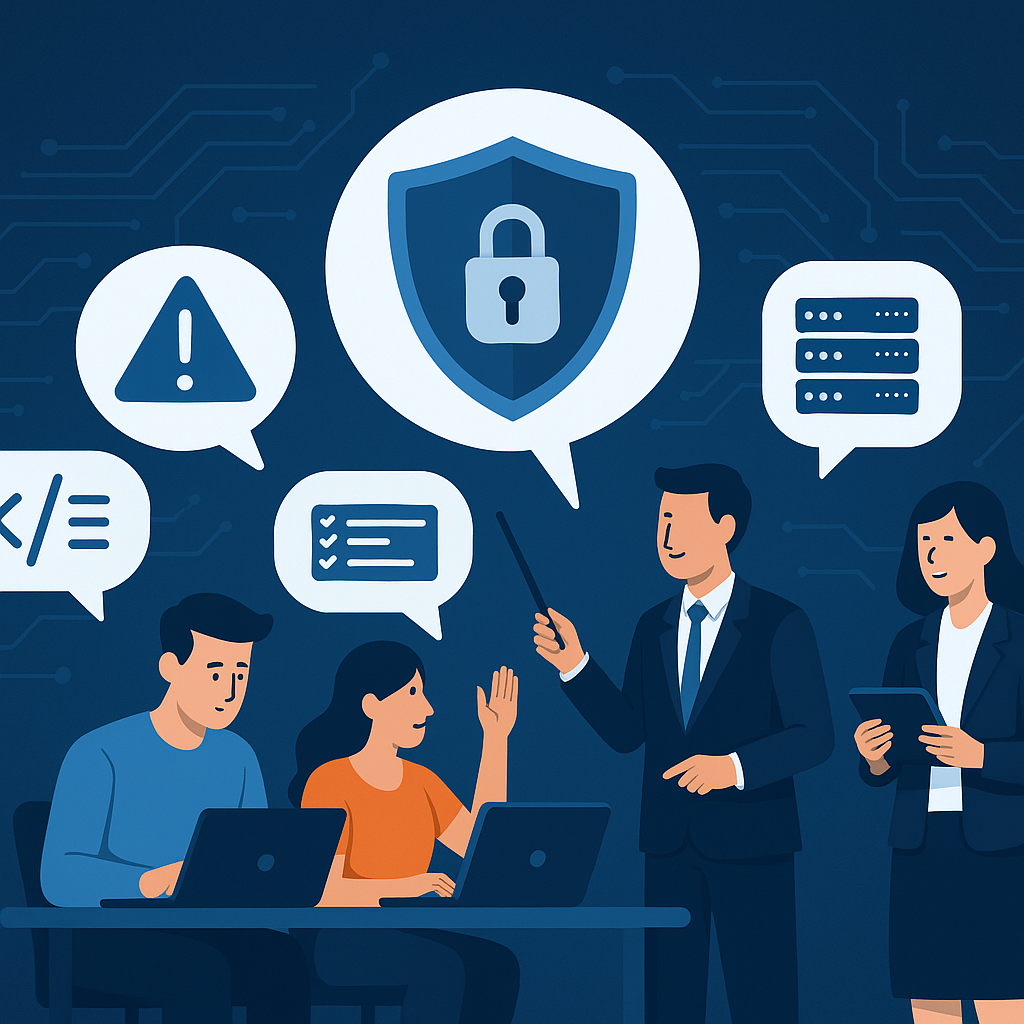
What Type of Security Training Delivers the Best Results for Modern Organizations?

Insights from CloudCamp

November 17, 2025

As organizations move deeper into the cloud, adopt DevOps practices, and introduce AI into everyday workflows, traditional security training is no longer enough. One-time awareness sessions, generic online courses, and certification-driven programs fail to address the depth, context, and collaboration required in modern environments. The most effective security training today is customized, continuous, role-specific, and integrated into real cloud and DevOps workflows. At CloudCamp, we help organizations choose the right training approach — one that creates measurable improvements in resilience, governance, and operational security.

1. Awareness Training: Necessary but Not Sufficient

Most companies start with security awareness training (e.g., phishing prevention, password hygiene, basic safe browsing).
This is foundational — but it doesn’t change how teams build, deploy, or govern systems.

Awareness training helps with:

  • Reducing phishing risk
  • Creating cultural baseline
  • Improving general security understanding

But awareness alone does not:

  • Prevent cloud misconfigurations
  • Improve DevOps security
  • Establish governance
  • Prepare teams for incidents

Awareness is the first step — but far from the last.

2. Role-Based Security Training Has the Biggest Impact

Modern security requires every role to understand how their decisions impact risk.

Effective organizations deliver role-specific training for:

🔹 Developers

Secure coding, secrets management, dependency scanning, threat modeling.

🔹 DevOps / Platform Teams

Pipeline security, IaC scanning, policy-as-code, identity enforcement.

🔹 Cloud Engineers

IAM, network segmentation, encryption, logging, monitoring.

🔹 Security Operations (SecOps)

Threat detection, response playbooks, automation, SIEM tuning.

🔹 Leadership

Governance, compliance, risk frameworks, accountable decision-making.

This ensures security is embedded where the work actually happens.

3. Hands-On, Environment-Based Training Works Best

The biggest mistake enterprises make is sending teams to training that uses simulated or generic labs.
These environments never match your organization’s complexity, policies, or cloud architecture.

Teams learn best when training uses:

  • Your real cloud environment (Azure, AWS, GCP)
  • Your landing zones
  • Your access policies
  • Your CI/CD pipelines
  • Your governance rules
  • Your monitoring tools

CloudCamp specializes in environment-mapped training, so teams build skills that apply immediately.

4. DevSecOps Training Creates the Fastest Security Maturity Growth

Security must move left — into development and operations workflows.

Effective DevSecOps training teaches teams how to:

  • Shift security checks earlier
  • Automate vulnerability scanning
  • Enforce security in pipelines
  • Integrate policy-as-code
  • Use GitHub Advanced Security, Defender for Cloud, etc.
  • Collaborate across Dev, Ops, and Security

Organizations that adopt DevSecOps training reduce:

  • Misconfigurations
  • Deployment failures
  • Vulnerabilities
  • Manual review bottlenecks

DevSecOps is now the highest-ROI security training for enterprise teams.

5. Governance & Compliance Training Ensures Long-Term Resilience

Technology alone cannot guarantee security — governance does.

Every organization needs training in:

  • Zero-trust architecture
  • Identity & least privilege
  • SOC 2 / ISO 27001 readiness
  • Cloud policy enforcement
  • Audit preparation
  • Data protection (GDPR, HIPAA, etc.)

CloudCamp helps leadership and compliance teams understand how governance integrates with cloud and DevOps practices.

6. Incident Response & Simulation Training Creates True Readiness

Most organizations discover weaknesses during — not before — an incident.

Simulation-based training prepares teams for:

  • Cloud breaches
  • Credential theft
  • Ransomware
  • Pipeline compromise
  • Data exposure incidents

This type of training includes:

  • Tabletop exercises
  • Live-fire simulations
  • Cross-team coordination
  • Remediation drills
  • Communication & escalation frameworks

Organizations that practice incidents recover 4× faster.

7. Continuous Training Outperforms One-Time Programs

Threats evolve weekly.
Cloud services change monthly.
AI is accelerating daily.

Security training must be:

  • Ongoing
  • Role-based
  • Updated regularly
  • Reinforced with micro-learning
  • Measured with KPIs

CloudCamp builds continuous enablement programs, not one-off workshops.

Conclusion

The most effective security training for modern organizations is:

✔ Customized

✔ Role-specific

✔ Hands-on and environment-based

✔ Governance-aligned

✔ DevSecOps-focused

✔ Simulation-driven

✔ Continuous

This is how organizations build true security capability, not just “awareness.”

CloudCamp helps enterprises embed security into every workflow — from development and operations to compliance and leadership.

Explore More Ingishts:

A group of six diverse coworkers engaged in a meeting around a table in a modern office.

We built a 3-day Azure DevOps Enablement Program for a public agency team migrating to GitHub.

Book a Discovery Call