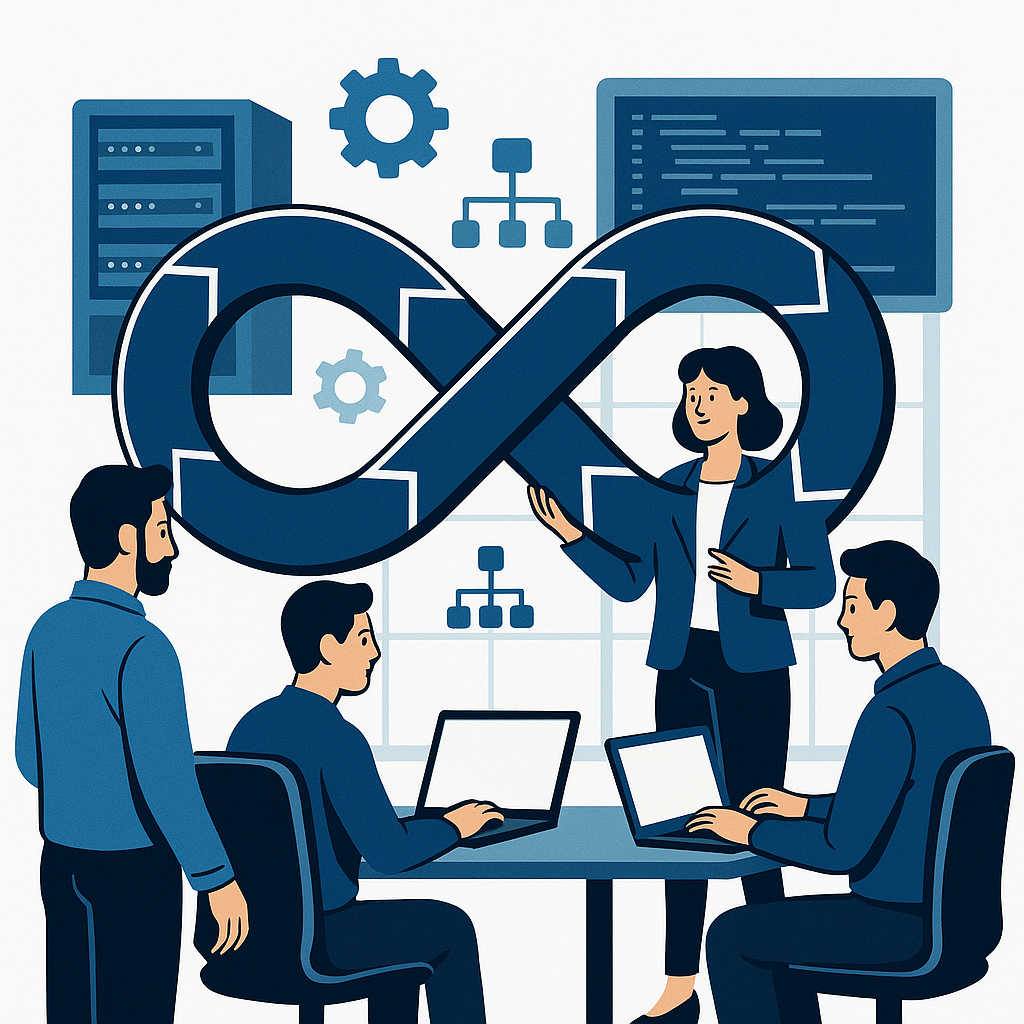
1. Automation Breaks When Teams Don’t Share the Same Mental Model
Automation requires a consistent understanding of:
- How environments are built
- How pipelines are structured
- What “done” means
- What security checks look like
- How IaC modules should be consumed
- How testing must be integrated
But most teams have siloed knowledge.
Developers automate differently than Ops.
Ops automates differently than Platform.
Security adds controls late in the process.
Without a shared mental model, automation becomes fragile and inconsistent.
CloudCamp Training Focus:
Cross-team DevOps enablement sessions to align patterns, terminology, expectations, and workflow ownership.
2. Pipelines Fail When Developers Aren’t Trained in Operational Requirements
Developers often don’t receive training in:
- Deployment strategies (blue-green, canary, rolling)
- Observability requirements
- Runbook automation
- Secrets management
- Cloud architectural constraints
- Identity & least-privilege patterns
Automation breaks because pipeline behavior doesn’t match operational rules.
CloudCamp Training Focus:
Developer-focused DevOps training mapped to your cloud, your pipelines, and your governance model.
3. Infrastructure-as-Code Fails Without Shared IaC Practices
IaC requires:
- Pattern reuse
- Module consistency
- Shared documentation
- Code review discipline
- Environment parity
- Automated validation
But most IaC failures happen because:
- Developers write IaC differently than Ops
- Different teams create duplicate modules
- No shared governance exists
CloudCamp Training Focus:
Hands-on IaC training across teams using shared templates and enterprise patterns.
4. DevSecOps Controls Break When Security Isn’t Trained in DevOps
Many security teams understand policy — but not pipelines.
Result:
- Controls added too late
- Misconfigured scanning tools
- Overly restrictive gates
- Friction between Dev, Ops, and Security
Security must learn:
- CI/CD workflows
- Container security
- Secrets automation
- Policy-as-code
- Identity-driven DevOps
CloudCamp Training Focus:
Security-enabled DevOps workshops that show how to embed policies into real pipelines.
5. Automation Fails Because Platform Teams Aren’t Teaching the Platform
Platform Engineering provides:
- Golden IaC modules
- Standardized pipelines
- Secure default configurations
- Self-service environments
But without training:
- Developers don’t consume the platform correctly
- Ops bypass guardrails
- Security misconfigures integrations
- Teams “roll their own” automation
CloudCamp Training Focus:
Platform adoption training across Dev, Sec, Ops, and Data teams.
6. Automation Breaks When Teams Only Know Their Piece
The biggest automation failures happen at the boundaries:
- Dev vs Ops
- Ops vs Security
- Security vs Platform
- Platform vs Developers
- Data vs Infra
These boundaries fail because teams don’t understand how their work impacts the next stage.
Cross-team training is the only way to eliminate these blind spots.
CloudCamp Training Focus:
End-to-end DevOps flow simulations using your toolchain and your cloud architecture.
Conclusion
DevOps automation doesn’t break because tools are bad.
It breaks because people aren’t aligned, trained, or collaborating effectively.
Real DevOps maturity requires:
- Shared mental models
- Cross-team upskilling
- Hands-on learning in real environments
- Consistent pipeline patterns
- DevSecOps integration
- Platform Engineering adoption
- Governance-driven automation
CloudCamp helps enterprises build the cross-team DevOps capability that automation needs to actually work.