
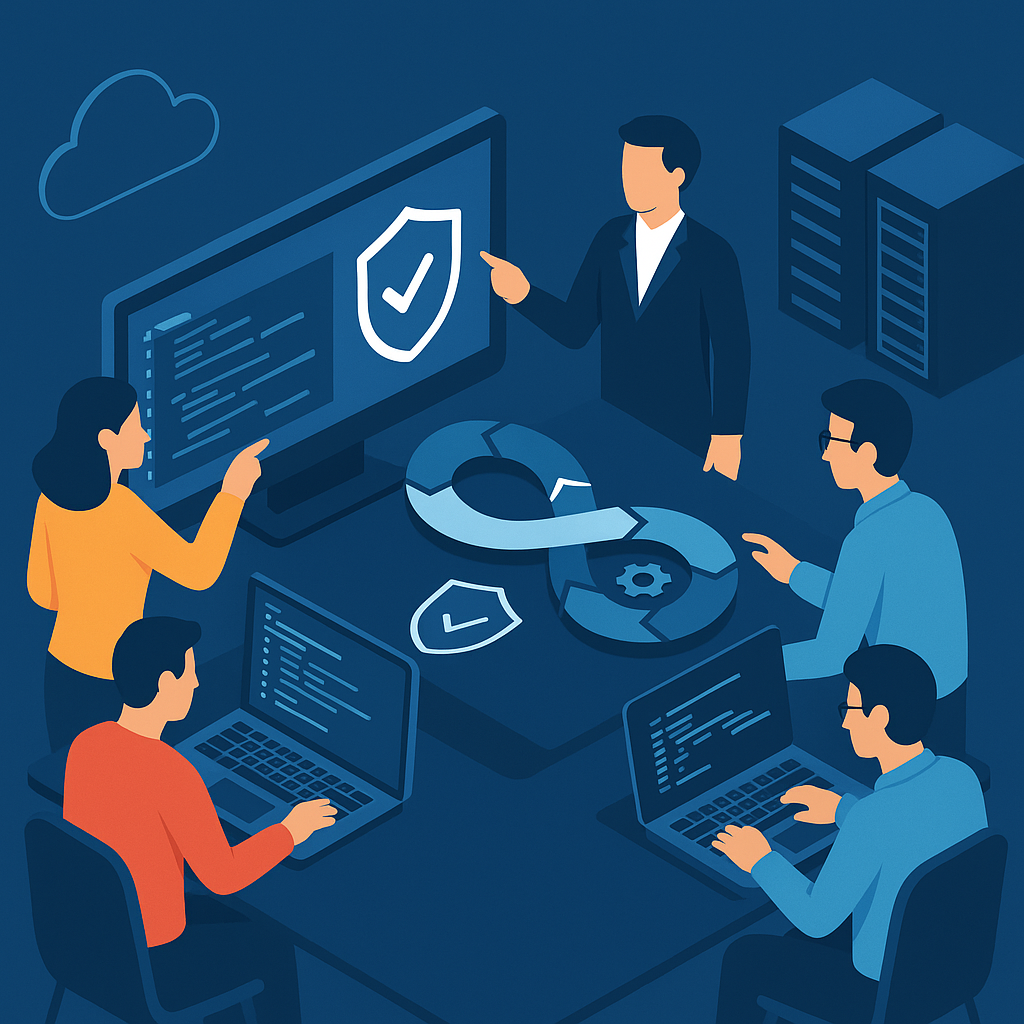
From DevOps to DevSecOps: Embedding Security Into Every Workflow

Insights from CloudCamp

November 8, 2025

Modern development moves fast—but often faster than security can keep up. In many organizations, security checks happen too late in the process, creating friction between developers and security teams. DevSecOps changes that. It embeds security directly into the development lifecycle, ensuring every line of code, every deployment, and every pipeline is secure by design. At CloudCamp, we help enterprises make this shift seamlessly by combining automation, governance, and hands-on enablement.

1. What DevSecOps Really Means

DevSecOps isn’t just DevOps with an extra step—it’s a mindset shift.
Instead of treating security as a gate at the end of deployment, it becomes a shared responsibility throughout the workflow.

That means:

  • Developers integrate security from the start of the build.
  • Operations teams manage secure infrastructure and automation.
  • Security teams collaborate, not audit.

This alignment reduces risk without slowing innovation.

2. Why Security Must Move Left

In traditional models, security comes in after code is written—when issues are hardest and most expensive to fix.
By shifting left, security becomes part of design and development from day one.

CloudCamp’s DevSecOps training helps teams:

  • Identify vulnerabilities early in CI/CD pipelines.
  • Automate testing for compliance and policy validation.
  • Use tools like GitHub Advanced Security, Snyk, and Azure Defender.

The result: faster delivery, fewer breaches, and greater confidence in every release.

3. Automating Security Without Slowing Teams Down

The biggest misconception about security is that it slows development.
In reality, automation makes it faster and safer.

Through hands-on labs, we teach teams how to:

  • Automate vulnerability scans and code reviews.
  • Integrate secrets management and least-privilege access.
  • Enforce compliance automatically within workflows.

Security automation transforms DevOps pipelines into trust pipelines—continuous, monitored, and compliant by default.

4. Collaboration Over Silos

DevSecOps only works when teams collaborate across disciplines.
That’s why CloudCamp training includes role-based simulations where:

  • Developers learn security thinking.
  • Security professionals learn automation and pipelines.
  • Leaders learn governance integration.

When these groups align, security stops being a bottleneck—it becomes a catalyst for speed and reliability.

5. Measuring DevSecOps Success

You can’t improve what you can’t measure.
We help organizations define success metrics, such as:

  • Mean time to detect and remediate vulnerabilities.
  • Number of automated compliance checks per release.
  • Reduction in security incidents post-deployment.

When metrics improve, you don’t just prove compliance—you demonstrate security maturity.

Conclusion

DevSecOps isn’t just about tools or pipelines—it’s about culture, automation, and accountability.
When done right, it builds a system where innovation and security coexist seamlessly.

At CloudCamp, we help enterprises embed security in every workflow—so teams can move fast and stay secure.

Explore More Ingishts:

A group of six diverse coworkers engaged in a meeting around a table in a modern office.

We built a 3-day Azure DevOps Enablement Program for a public agency team migrating to GitHub.

Book a Discovery Call